

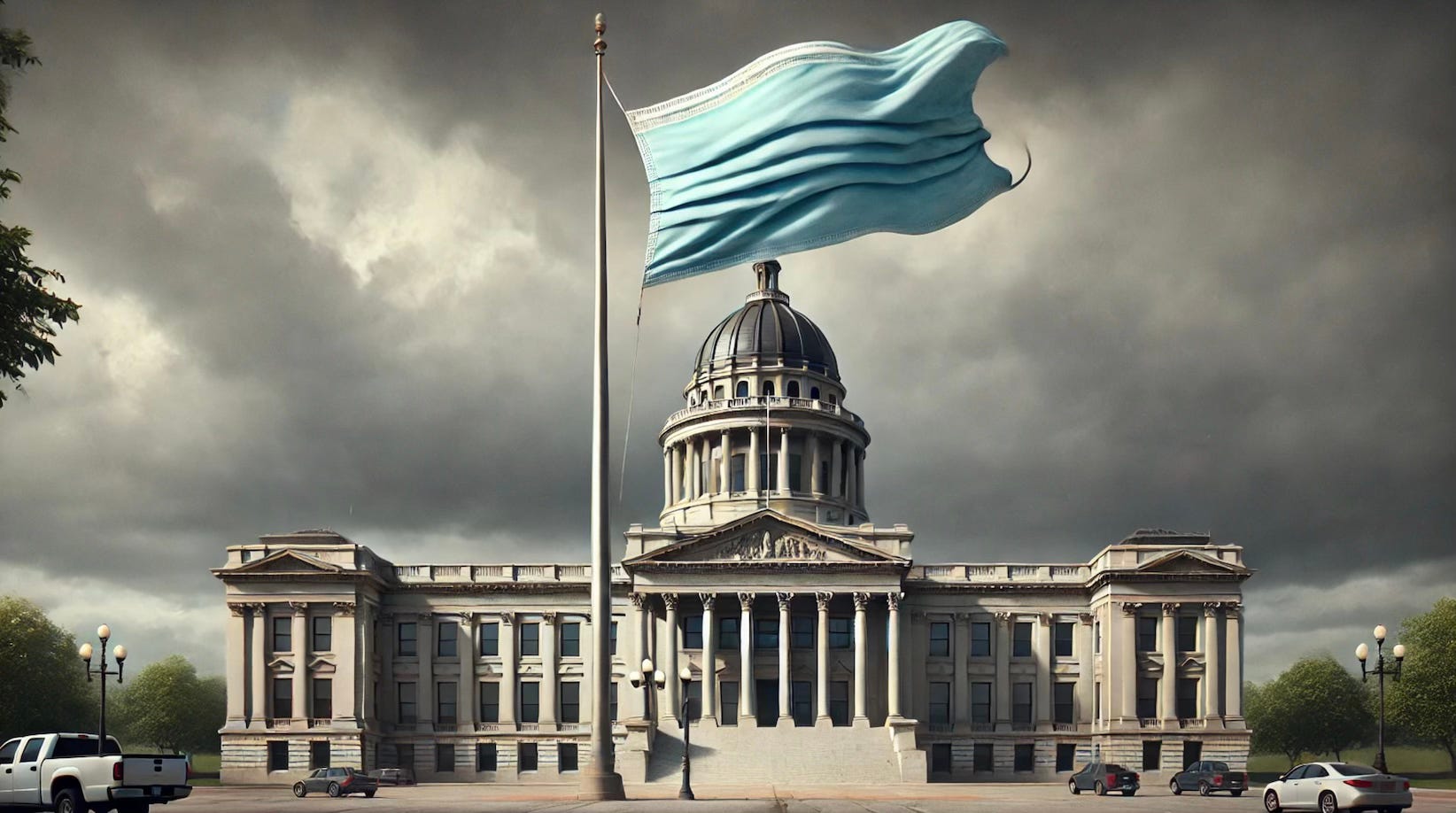
Six years on, the conventional wisdom about COVID remains oddly imprecise: that the United States should have had a more centralized response because the virus transcended borders. Even after reading a number of critiques, it’s unclear what that response would have looked like. The path that was ultimately taken, primarily by nature of the constitutional order but compounded by an inept national information ecosystem, was the dual-federalism path. The federal government didn’t fail in its response because it was mostly not its responsibility to respond. That duty rested with the states, and that is precisely what made the U.S. response, if not swift, then sustainable.
Many of the most prominent critiques of the American response were, at bottom, arguments for more national direction, even when they stopped short of spelling out the legal machinery. In September 2020, Ed Yong at The Atlantic portrayed national failure as the product of national incompetence and drift, as well as online misinformation that undermined expertise. In April 2020, the Center for American Progress called for “a national and state plan” and later endorsed a 45- to 60-day national stay-at-home policy as an “essential first step,” pairing it with mass testing, tracing, and isolation. Vox, in August 2020, lamented the lack of a “unified state or national response,” adding that “the patchwork we have created will allow coronavirus to spread” in a post gawking at crowds of people out on the water in Iowa’s Great Lakes region. What ran through these pieces was not always an explicit defense of federal coercion, but a recurring frustration that never seemed to articulate a concrete alternative that would have produced better outcomes on mortality and infection rates.
A stronger approach, like China’s, which used mass testing, sealed off villages and residential compounds, deployed wartime emergency footing, and enforced travel restrictions and lockdowns for extended periods of time, would not have been received well in the United States. Or take Australia, which deployed mass compulsory testing, sealed off neighborhoods, set hard movement limits, and aggressively enforced public defiance. Each of these would have faced explosive pushback in the United States in a year already defined by political unrest.
There’s the softer version — the cooperative-federalism approach — that instead would have perhaps seen states act more at the mercy of federal guidelines and coordination efforts. And in the early part of the pandemic, the efforts to “slow the spread” to give hospitals time to assemble the capacity to take on new patients, along with the early guidance around distancing, could be regarded as de facto cooperative federalism.

The trouble is that public health is fundamentally a dual-federalism issue, in which the federal and state governments have separate and distinct roles, the latter of which possessed much of the legally binding authority to carry out policies that may have done the most to limit transmission or illness. But despite this, the limited advisory role the federal government did have was undermined by several examples of conflicting, misleading, and politicized information from official agencies like the CDC, but also from a national public-health elite aligned with more prescriptive approaches to containment.
During the Trump period, the CDC stated and then walked back the idea that asymptomatic exposed people might not need testing. During the Biden period, the pattern was less overt interference than highly visible reversals, including the CDC’s claim that vaccinated people “don’t carry the virus,” a statement that was far too categorical and later looked plainly wrong as breakthrough infections mounted. Rochelle Walensky, the CDC director at the time, misrepresented her agency’s study on outdoor transmission rates. The phrase “pandemic of the unvaccinated” was also politically potent but too sweeping. Vaccination clearly reduced severe illness and death, but vaccinated people could still contract and transmit the virus.
Independent of either administration, national public-health figures also undermined trust. National Institutes of Health Director Anthony Fauci was a primary character here. Early on, he discouraged mask use for the general public, then later supported widespread masking, with later explanations about supply shortages making many people feel they had been managed rather than candidly informed. He also fed a “moving goalposts” perception when he acknowledged raising his public herd-immunity estimate in part based on what the public seemed ready to hear. Even when the underlying science was genuinely evolving, that style of communication made national guidance sound like strategic persuasion.
Independent of Fauci, the effectiveness of masking was overstated. While it was defensible to argue that masking helped some, especially better-fitted and higher-grade masks, expert messaging often projected more certainty and uniform effectiveness than the evidence warranted. That helped turn a limited precaution into a cultural wedge issue, encouraging an epidemic of hygiene theater. As far as national expertise went, the American Public Health Association didn’t do any favors toward earning public trust when the organization effectively excused mass social-justice protests during a phase marked by fervent insistence on social distancing, calling “racism a public health crisis.” At the same time, an open letter from 1,000 public-health professionals and community leaders circulated excusing the protests when masking and social distancing were being fervently preached to the broader public.
The national media also played a central role in eroding trust in national experts by pointing its scrutiny in one consistent direction and presenting unsettled questions with overconfident answers. The legitimate, and perhaps even likely, theory that the coronavirus was derived from a compromised lab in Wuhan was dismissed as a crackpot right-wing conspiracy theory. The idea that Trump told people to drink bleach was a lie; he never said that and his implication that light could be a disinfectant was a poorly-communicated prospect that did have serious scientific grounding.
. Real and safe human drugs like ivermectin, though not found to be an effective coronavirus treatment, were rebranded for months as horse dewormer. That led figures like Rachel Maddow to spread bold misinformation in the form of a fake story about gunshot victims in Oklahoma hospitals having care redirected away from them to treat patients who had overdosed on ivermectin. On vaccines, skeptics who early on said vaccination would not prevent transmission were treated as cranks despite this proving true once the vaccines were widely available and other strains emerged. Concerns about school closures were too often brushed aside as selfish or unserious, even as evidence mounted that prolonged remote learning was harming children’s mental health and derailing academic progress.

All of this is to say that states and localities did not fill a void left by a failed federal government. The response to COVID most relevant to Americans was firmly within the legal domain of the states.
Dual federalism may not have manicured an austere and technocratic response, but what it did do was make the response sustainable because it bound the most restrictive powers to locally accountable officials. In many respects, governors wield more unilateral power than presidents, which makes sense, as the U.S. constitutional order was designed with numerous impediments proportionate to the scale of the jurisdiction. Governors directed or heavily influenced schools, retail, and recreational gatherings. Trump’s claim of having “total authority” collapsed almost immediately going into April 2020, as his reopening plan was worth less than the paper it was printed on.
But it isn’t as though state decisions were met without resistance. Anti-lockdown backlashes in Michigan and Wisconsin were flashpoints as weeks of “sheltering in place” dragged on. In New York, Orthodox Jewish neighborhoods were targeted for closure. Across the Sun Belt, states moved in various ways, including by limiting capacity in certain public spaces, to tailor restrictions to what was palatable to the immediate public they were embedded among. That lockdowns were met with such resistance underscores the imprudence of an alternative response in which much of the discretion over these policies was left to a gridlocked and grandstanding Congress, a self-aggrandizing egotistic president, or an unaccountable federal bureaucracy covered by national media institutions with zero interest in challenging centralized information.
In a system where the core police power already rests with the states, that made policy variation less a failure of design than a reflection of both constitutional structure and epidemiological reality. In that sense, COVID’s border-crossing nature strengthened the case for federal coordination of information and resources, but not necessarily for a uniform national regime of closures and mandates.
COVID federalism, rightly, did not resolve division among Americans precisely because there are values and approaches to operating amid an epidemic that do divide Americans, perhaps irreconcilably. Yet there is a deeply entrenched notion that believes unity may simply be enforced through national uniformity. If only national authority figures could paper over the divisions with a prescriptive response, voila, this could have unified the country. Of course, that is never said aloud, but the logical path seems to unravel toward such a conclusion.
Division — the benign, nonviolent sort that recognizes clear divergences in culture, values, and needs — is not to be papered over in a democracy in the name of unity, nor should what constitutes democracy be conflated with channeling disputes through unrepresentative and distant national institutions. When people believe their own values, fears, and tradeoffs are at least partially reflected in the authority governing them, compliance becomes less a matter of coercion and more a matter of civic acceptance. In that sense, federalism did not merely disperse power, but provided a structure through which a divided people could remain civically associated without first becoming morally uniform. Relatedly, surveys after the height of the COVID era found governors, as well as state government, receiving higher approval and trust ratings than presidents and the federal government, respectively. None of this is to say a non-centralized response was ideal or did not pose its own risks, but in a hyper-nationalized, and thus divided, union, non-centralization doesn’t have to demonstrate superiority in every respect, only that it remained the stronger alternative.

Relatedly, COVID also taught us that ubiquity is a poor limiting principle for uniform rule. That a problem may emerge everywhere does not itself justify uniformity, either in principle or in practice. As with COVID, the virus did not affect all places at the same time, with the same severity, or always among the same groups of people. One will recall that outbreaks of new strains into 2020 and 2021 ebbed and flowed by region. Enhancing the coordination of material resources at the federal level has its advantages, but as far as policy powers go, it would have faced not only principled resistance but practical challenges as well, with technocrats who enjoyed little public trust left either to impose uniform limits on economic and educational activity or to micromanage such activity at the local level — both of which seem untenable. A free society needs a limiting principle for federal public policy when confronting major challenges, including lethal ones, that transcend state borders, because when it comes to morally fraught questions, the surest way a divided people remain united in their fundamental commitments is by giving them more avenues to express their views on governance rather than channeling those views through a single institution meant to represent a consensus among the whole that does not exist.
The federal government played a crucial role in doing what it does best: lending aid amid an initial massive disruption to the labor market and marshaling the resources to accelerate vaccine development. At the same time, COVID exposed not just the principled and constitutional limits of federal power, but the practical ones as well, revealing how easy it is to overvalue solutions while undervaluing the importance of communicating them through trusted expert and media institutions. The American response to COVID varied because outcomes in any democracy of its size and complexity will vary. Much as tolerating speech we disfavor is a test of the resilience of free expression, so too is deferring life-altering questions to institutions proximate to the people a test of democracy committed to remaining plural.

Let's all remember the meaning of federalism. It means that local government has a certain amount of independent authority, apart from the central authority. When the thirteen original states of the USA created the federal government, they did so in such a manner that the central government could never take control.
They were only partially successful in this effort. At any rate, there is no reason to presume that the central authority is able to better represent the people of a state than that state's own government, which the citizen's elected.
As for COVID, the greatest disaster was government reaction, more so than the disease itself. We saw science replaced with scientism. Scientism, which has no real definition that I know of, is when people try to substantiate myth with claims of science. Not surprisingly, politicians and bureaucrats chose to do whatever gave them the most power, control and influence over citizens, rather than to rationally (scientifically) approach the issue.
I've been around a long time. I've never seen insightful, rational government. But what I've seen over the last five or so years is downright frightening. Forget COVID. The bigger problem is politically centered bureaucracies with ever increasing power.